Digital waste tracking in Northern Ireland: the 2027 mandate
Listed on GOV.UK as a compatible software providerNorthern Ireland is due to make digital waste tracking mandatory in January 2027. The rule is still a draft statutory rule before the Assembly, so the date is the published plan rather than law already on the statute book. When it comes into operation, permitted sites that receive controlled waste will record every load in the Digital Waste Tracking Service, and DAERA will enforce the duty.
The service is Defra's UK-wide one. The later date is not the whole story for a site near the border: waste that crosses into the Republic is covered by EU shipment rules that have applied here since May 2026. The two duties are separate, and this page covers both.
When the Northern Ireland mandate starts
The draft rule is the Digital Waste Tracking Regulations (Northern Ireland) 2026. DAERA's SL1 says it is to come into operation in January 2027 and is subject to draft affirmative resolution. The GOV.UK service page, updated on 19 October 2026, also gives January 2027 for Northern Ireland and Scotland. October 2026 was the original date and now applies to England and Wales only.
The public beta has been open to Northern Ireland sites since April 2026, so a site can use the service now. The change in January is that use becomes a legal duty.
Who has to report
The draft rule places the duty on the operator of a permitted facility, defined as a facility with a waste management licence under the 2003 Regulations or a PPC permit. In practice that means the sites that receive waste: transfer stations, scrap yards, landfills, energy from waste plants and composting sites.
The draft rule does not apply to a facility operated by a district council. DAERA's screening note describes the duty more broadly, as applying to any legal entity registered to receive waste in Northern Ireland. The made rule will settle the exact scope. If your authorisation is unusual, check with DAERA before you build a process around the wording. Our who needs DWTS guide covers the common site types.
What a load record contains
The draft rule sets out the specified information. In practice, a record carries the waste code and description, the quantity and unit, whether the waste is hazardous, any persistent organic pollutants, the carrier's name and registration number, the receiving site, and the date and time the load arrived. The service returns a unique reference number for each record, and that number is your proof of receipt.
One record per load, not one per day. The deadline is the end of the second working day after the day of receipt, with working days counted as days that are not weekends or bank holidays. Once the rule applies, a load received at 9am on Monday will need to be in the service by 11:59pm on Wednesday. If the service is down, the draft rule sets out an outage process: notify the Department, keep a written record by the same deadline, and enter it into the service within seven days of the outage ending.
Hazardous waste and POPs
Hazardous waste adds fields to the record: the hazardous waste data, the consignment note number, and persistent organic pollutant data where the waste contains POPs. If your site takes hazardous waste, check that the waste code and the consignment note agree before the load is booked in. A mismatch between the two is easier to fix at the gate than after the record has gone in.
What happens when a load arrives
The gate records the carrier, the waste code and the weight, and the driver signs. The record goes to the service, which returns a reference number. The reference is stored against the load, and the PDF is available to download. If the waste code or weight is wrong, correct the record in the service, because the correction is part of the audit trail. Keep the reference number with the load record. A rejection is not a filing, so correct it and resubmit. The PDF and the reference belong with the rest of the site's waste records.
What the mandate does not change
The mandate adds a record of receipt. It does not replace the waste transfer note, the duty of care, the hazardous waste consignment note or carrier registration. A transfer note still travels with the waste and records the transfer between the parties. A hazardous load still needs its consignment note. A carrier still needs the registration that lets it transport waste. DWTS sits alongside those duties, which is why the gate routine is the place to join them up rather than a separate job at month end.
More than one site or organisation
A Defra account can hold more than one organisation, but each organisation registers separately and pays its own £26 charge. A group with three operating companies has three registrations and three annual charges. Sites that share one organisation share the registration, which is the usual arrangement for one company with several yards. DAERA enforces the duty through the Northern Ireland Environment Agency (NIEA), but Defra runs the service, so registration, the API and the reference numbers come from Defra.
Penalties when the rule comes in
The draft rule sets penalties in regulation 18. An offence will be punishable on summary conviction by a fine not exceeding the statutory maximum, and on conviction on indictment by an unlimited fine. It also provides for fixed monetary penalties, variable monetary penalties, compliance notices and recovery of enforcement costs.
The practical risk is the gap, not the headline fine. A missing record is visible in the service, and a site that cannot show a record for a load has no answer when DAERA asks.
If the draft rule changes
The Assembly can amend the draft before it is made. The scope and the commencement date could move, which is why this page says January 2027 is the plan rather than the law. A site should prepare on that basis, but check the made rule before it changes a contract or a booking process.
Moving waste across the border
A Northern Ireland waste site can owe two different returns for the same load, depending on where it goes. DWTS records what the site receives. The EU Waste Shipment Regulation governs what crosses the border. They do not share data, and filing one does not file the other.
Northern Ireland is not in the EU. Under the Windsor Framework, the EU waste shipment rules apply there, and Northern Ireland is treated as if it were a Member State for those rules. Regulation (EU) 2024/1157 replaced Regulation (EC) 1013/2006 and has applied since 21 May 2026.
| Movement | What the EU rules call it | What it means in practice |
|---|---|---|
| Northern Ireland to the Republic of Ireland | Intra-EU shipment | Notifiable shipments go through DIWASS |
| Northern Ireland to Great Britain | Export out of the EU | Prior informed consent where the shipment is notifiable |
| Great Britain to Northern Ireland | Import into the EU | The EU side handles the import notification in DIWASS |
| Northern Ireland to Northern Ireland | Domestic | DWTS only; DIWASS does not apply |
Great Britain is outside the Waste Shipment Regulation, but it is not outside DIWASS. A GB operator named on an EU shipment must be registered in DIWASS to be selectable.
DIWASS is the Commission's Digital Waste Shipment System. It has been mandatory for notified shipments involving an EU country since 21 May 2026, and Northern Ireland operators use it. Green list waste keeps its Annex VII paperwork, mostly on paper, until 31 December 2026. Commercial software can connect by API under Implementing Regulation (EU) 2025/1290, but the operator must first be registered in DIWASS and have a GUI user authorised to request the connection.
LoadLog records loads and files DWTS returns. It does not file DIWASS notifications and is not a DIWASS software provider. If you ship waste across the border, you need DIWASS as well as DWTS, and you should plan for both.
NIEA is the competent authority for the EU rules in Northern Ireland. Ask NIEA which access route applies to your site before you choose software for shipment notifications.
Carrier checks that cover Northern Ireland
A carrier's registration number is a required field, and the register it belongs to matters. LoadLog checks all four UK public registers, including the one for Northern Ireland, at the point the record is created. A number that does not match is flagged while the driver is still at the gate, not discovered weeks later when a return is rejected.
For sites near the border, this matters twice over: a load can arrive behind a carrier registered on either side, and both are checked in the same flow.
How LoadLog handles the return
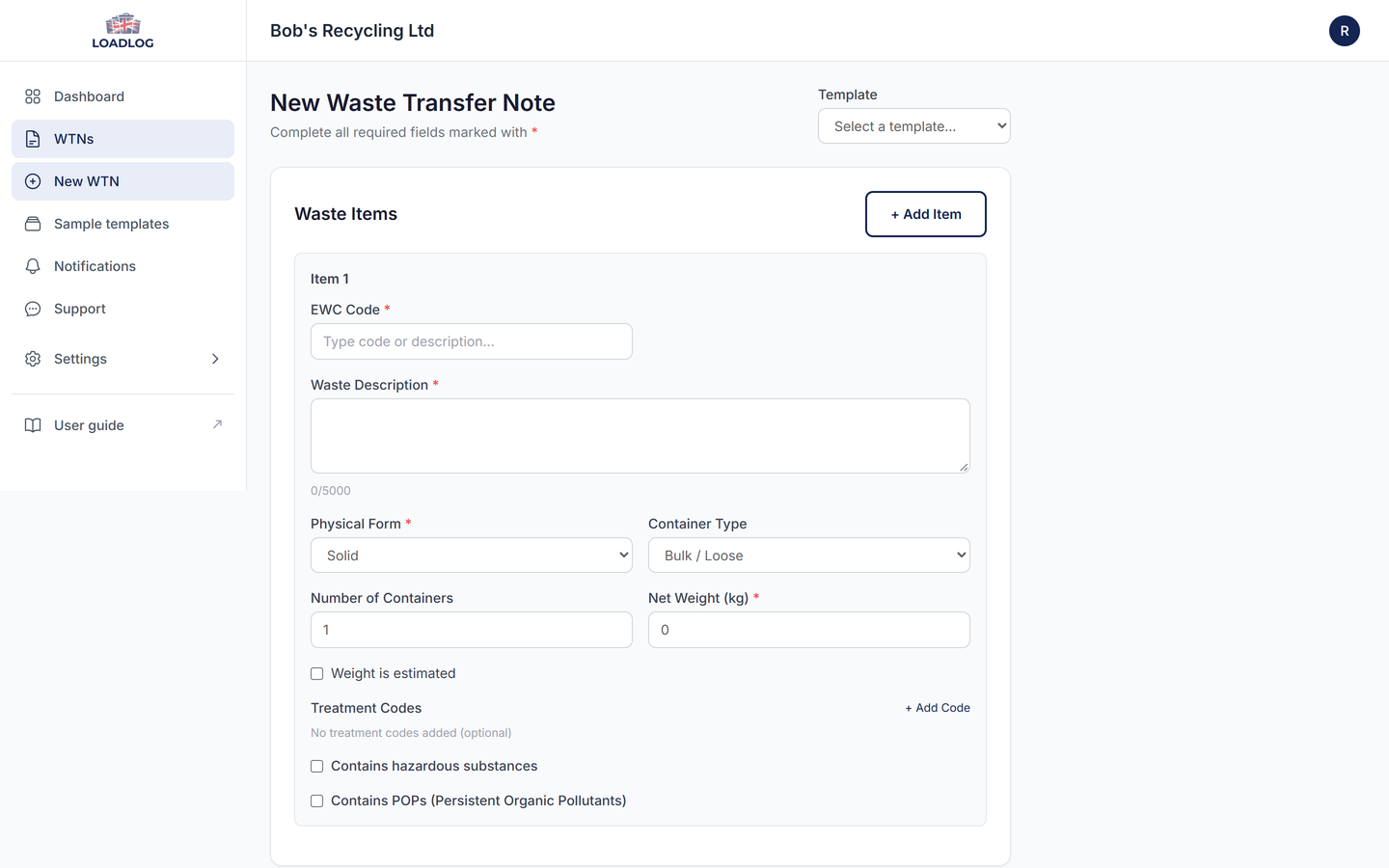
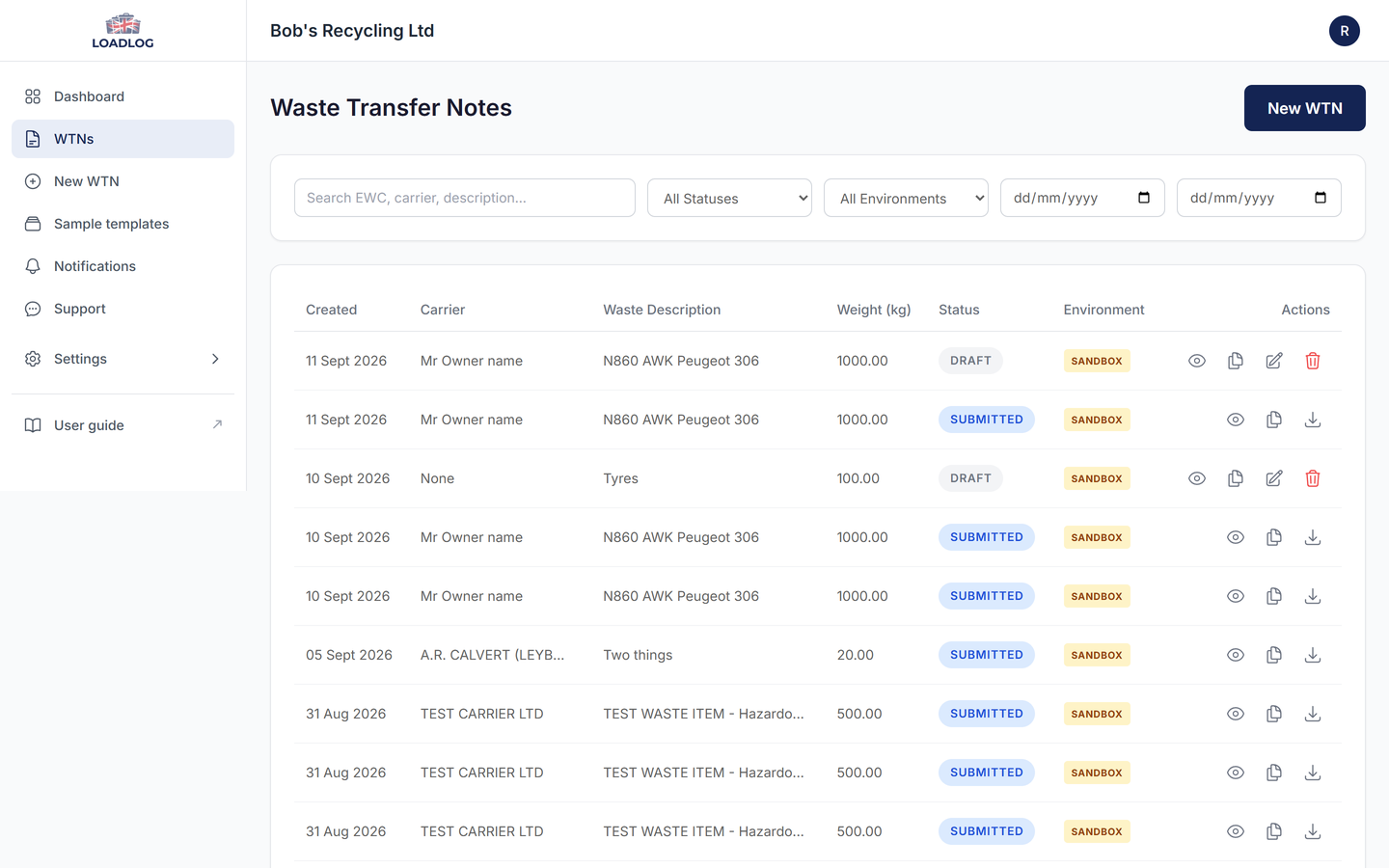
LoadLog creates the record at the gate, checks the carrier number against the public registers, submits the record to Defra and stores the reference number against the load. The notes list shows which records have a reference and which are still waiting, so a missing submission is visible before DAERA notices it. The PDF is generated from the same record, so the paperwork and the return cannot drift apart.
What to do before January 2027
Register the organisation for the service and get the API code. The annual charge is £26 per organisation, and the first payment is due by 31 January 2027. Then connect the code in LoadLog and prove the whole flow in the sandbox. Set up templates for the loads you see every day, and use import for anything your weighbridge already records. Our register guide and first submission walkthrough cover the steps.
If you ship waste across the border, list those movements now and ask NIEA which DIWASS route applies to your site. A site taking a handful of loads a week can build the DWTS habit on the free plan. Compliance Lite removes the monthly note limit when volume makes that worthwhile.
Sites that also operate in Scotland should read the Scotland page, which covers the made regulations, the exclusions and SEPA's role.
Two months free for waste sites in Northern Ireland: take up Compliance Lite before 18 December 2026 and your first two months are free, counted from the day the plan goes live on your account.
Start free →Frequently asked questions
When does digital waste tracking become mandatory in Northern Ireland?
January 2027 is the published plan. The statutory rule is still before the Assembly, so the date is not yet law.
Is the Northern Ireland rule law yet?
No. The draft rule is subject to draft affirmative resolution. DAERA's SL1 gives January 2027 as the intended commencement.
Who must report in Northern Ireland?
Operators of permitted facilities that receive controlled waste, meaning sites with a waste management licence or a PPC permit. The draft rule does not apply to facilities operated by a district council.
What is the deadline for each load?
The end of the second working day after the day the load arrives. Once the rule applies, a load received at 9am on Monday will need to be in the service by 11:59pm on Wednesday.
What are the penalties?
On summary conviction, a fine not exceeding the statutory maximum. On indictment, an unlimited fine. The draft rule also provides for fixed and variable monetary penalties, compliance notices and recovery of enforcement costs.
Does DWTS cover waste sent to the Republic of Ireland?
No. DWTS records waste received at a Northern Ireland site. A shipment to the Republic is covered by the EU Waste Shipment Regulation and, where the shipment is notifiable, by DIWASS.
Do I need DIWASS as well as DWTS?
If you move notifiable waste across the border, yes. DIWASS has been mandatory for notified shipments involving an EU country since 21 May 2026.
Does LoadLog file DIWASS notifications?
No. LoadLog files DWTS returns. DIWASS is a separate system run by the European Commission.
Is Northern Ireland in the EU?
No. Under the Windsor Framework the EU waste shipment rules apply there, and Northern Ireland is treated as if it were a Member State for those rules.
How much does it cost?
Defra charges £26 a year for each organisation, and the first payment is due by 31 January 2027. LoadLog's free plan covers five notes a month. Compliance Lite is £12 a month for unlimited notes.
Can we start before January 2027?
Yes. The public beta has been open to Northern Ireland sites since April 2026, and the service is open UK-wide.
Compliance Lite is £12 a month, and waste sites in Northern Ireland get their first two months free if you take it up before 18 December 2026, counted from the day the plan goes live on your account.